
|
|
| POLSKA | POLAND |
| województwo: Dolnośląskie | voivodship: Lower Silesia |
| powiat: Kłodzko | county: Kłodzko |
map →
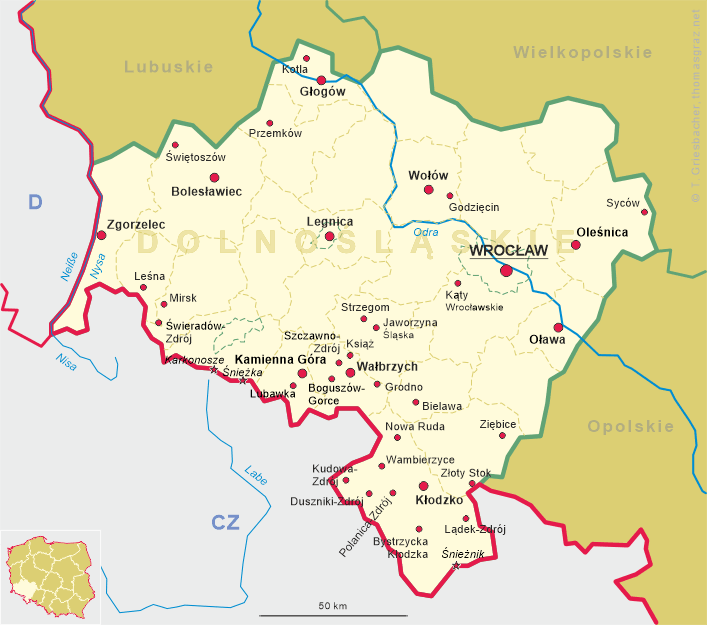
Nowa Ruda is situated at an elevation of 360 m in southwestern Poland, about 20 km northwest of the district town Kłodzko and about 70 km southwest of Wrocław, the capital of Lower Silesia. The municipality has a population of about 20,400 (2024).
Nevwenrode was first mentioned in a written document in 1337; further documents mention Neunrod (1346), Nowinrade and Newenrode (1352. The privileges of a town were granted in 1434. The town was destroyed during the Thirty Years' War (1618–1648). Following the First Silesian War in 1742, and finally with the Treaty of Hubertusburg in 1763, Neurode, together with the County of Glatz (Kłdsko), passed to Prussia. From 1854, following the division of the district Glatz, until 1932 Neurode was the administrative centre of the district Neurode. The railway line from Glatz (Kłodzko) to Waldenburg (Wałbrzych) opened in 1879. As a result of the Second World War, Neurode, along with most of Lower Silesia, came under Polish administration; the German place name was officially changed to the Polish Nowa Ruda. The majority of the German population was expelled in 1946 and 1947. From 1954 to 1975, Nowa Ruda was the administrative centre of Noworudzki County; thereafter, it belonged to the Wałbrzych Voivodeship until 1998; since then, it is part of the voivodeship Kłodzko.
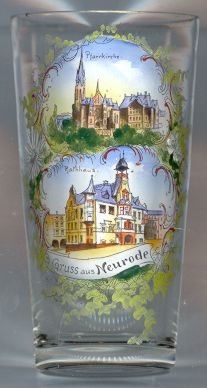
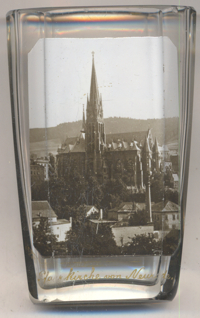
The  catholic parish church of St. Nicholas [left, no. 1340: top left,
and right, no. 3485] was built in Neo-Gothic style in 1885–1887. It replaced the old church that had
been built by Andrea Carova in 1659 and was destroyed by fire in 1844. The characteristic spire has a height of 66 m.
catholic parish church of St. Nicholas [left, no. 1340: top left,
and right, no. 3485] was built in Neo-Gothic style in 1885–1887. It replaced the old church that had
been built by Andrea Carova in 1659 and was destroyed by fire in 1844. The characteristic spire has a height of 66 m.

The Town Hall [far left, no. 1340: bottom picture, and near left, no. 4961] was
built in 1892 in Neo-Renaissance style by the architect Ewald Berger.
The actor and writer Friedrich Kayssler (1874–1945) was born in Nowa Ruda.
[https://de.wikipedia.org/wiki/Nowa_Ruda]
![[scale]](lineal.jpg)