
|
|
| DEUTSCHLAND | GERMANY |
| Bundesland: Nordrhein-Westfalen | North Rhine-Westphalia |
| Regierungsbezirk: Detmold | |
| Kreis: Lippe |
map →

Lemgo is situated at an elevation of 100 m in the Bega Valley in the hilly Lipper Bergland, a low mountain range in the north of the district of Lippe, in the north-east of the state of North Rhine-Westphalia, about 10 km northeast of Detmold, the administrative centre of the district Lippe, and about 26 km east of Bielefeld, and about 172 km northeast of North Rhine-Westphalia's capital, Düsseldorf. The municipality of Lemgo has a population of about 39,900 (2024).
Lemgo was founded 1190 by Bernhard II, Lord of Lippe, at the crossroad of two merchant routes and therefore is the oldest town in the Lippe district. Lemgo was a member of the Hanseatic League, a medieval trading association of free or autonomous cities in several northern European countries such as the Netherlands, Germany and Poland. During the Reformation the city of Lemgo adopted Lutheranism in 1522, whereas otherwise in Lippe, its spread was hampered until 1533 by the opposition of the then Catholic ruling counts of Lippe. In 1605 Simon VI, Count of Lippe, adopted Calvinism and demanded the conversion of Lemgo's citizens too using his monarchic privilege. However, the city defied the edict to convert to Calvinism, leading to the Revolt of Lemgo. This religious dispute was resolved by the Peace of Röhrentrup in 1617, granting Lemgo the right to determine its faith independently. Lippe's Lutheran minority, mostly domiciled in Lemgo, only joined the else Reformed Church of Lippe in 1882, however, retaining its Confession of Augsburg with the Lutheran congregations forming a separate classis within the Lippe church since 1888. Lemgo's historic centre survived World War II completely undestroyed. Thus, the overall urban character with the testimonies from the time of the Renaissance was preserved. From 1947 until 1993, Lemgo hosted successive infantry battalions of the British Army, the last one being the Royal Irish Regiment.
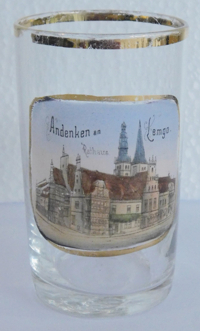
The  town hall [left, no. 4968: foreground] in the style of the Weser Renaissance,
which was included in the UNESCO list of works of European renown, consists of parts built at different times. The oldest part is an
elongated hall building dating back to the 13th century. The middle part of the building is built in Gothic style and dates from
around 1480 to 1490. It houses the Council Chamber, including the Court Arbour. The most recent part of the building in Weser Renaissance
architecture date from the 15th and 16th centuries.
town hall [left, no. 4968: foreground] in the style of the Weser Renaissance,
which was included in the UNESCO list of works of European renown, consists of parts built at different times. The oldest part is an
elongated hall building dating back to the 13th century. The middle part of the building is built in Gothic style and dates from
around 1480 to 1490. It houses the Council Chamber, including the Court Arbour. The most recent part of the building in Weser Renaissance
architecture date from the 15th and 16th centuries.
The parish church Sankt Nicolai [left, no. 4968: background] is the older of the two
Lutheran parish churches in Lemgo. The earliest church, a Romanesque basilica, was built soon after 1190. Around 1300, it was decided to
demolish the narrow side aisles of that church and build new ones that were almost as high and as wide as the nave. This resulted in a
hall church in the Gothic style; only the area around the towers retained its Romanesque features. By 1375, the church had taken on its
present form. Although plans were in place to make the chancel even larger, these were never carried out because a plague epidemic brought
construction work to a halt. The spire of the northern tower was blown off by a storm in 1660, which also damaged parts of the roof at the
time. Three years later, it was decided to fit the tower with a twisted spire, which is less susceptible to the wind.
[https://de.wikipedia.org/wiki/Lemgo, https://en.wikipedia.org/wiki/Lemgo;
https://de.wikipedia.org/wiki/St._Nicolai_(Lemgo)]
![[scale]](lineal.jpg)